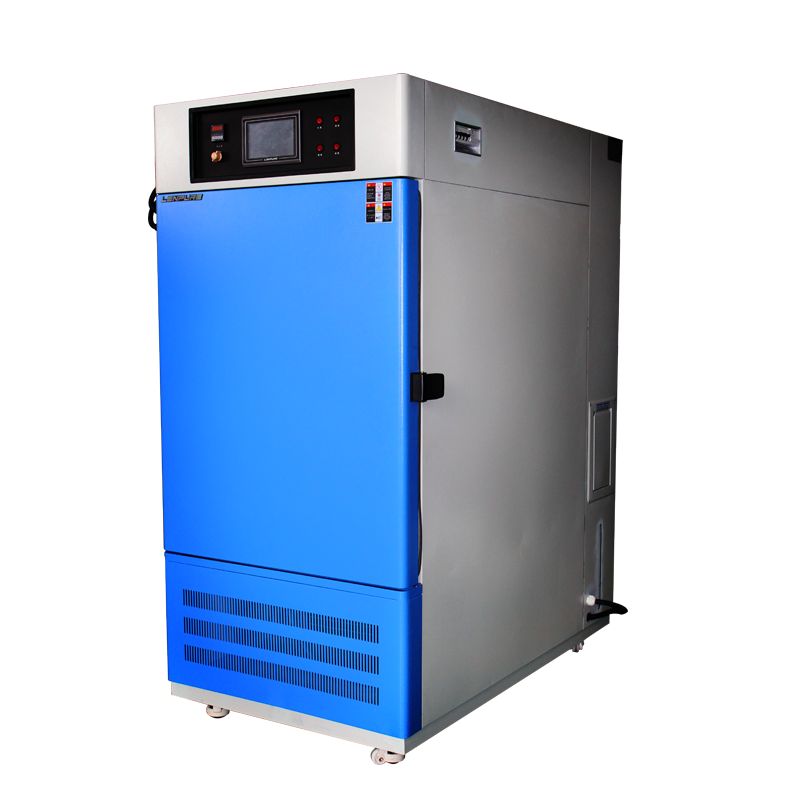
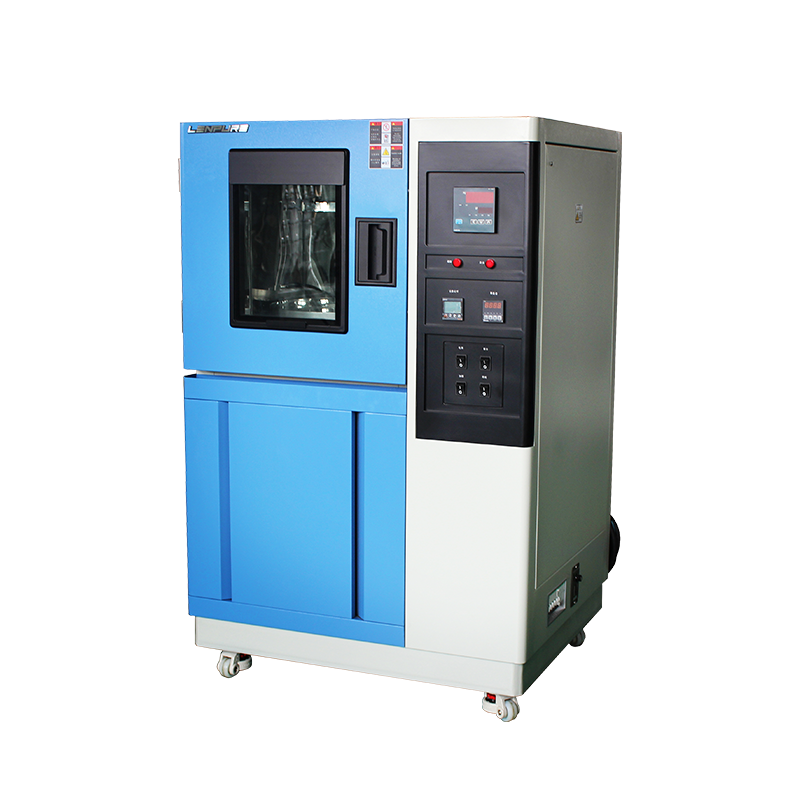
The UV aging test chamber is a device that simulates ultraviolet radiation and condensation climate environments by using fluorescent ultraviolet lamps as the light source. It tests the light resistance of non-metallic products or materials and the aging effects of artificial light sources, thereby evaluating the weather resistance of the products or materials. The test chamber can replicate natural climate phenomena such as ultraviolet radiation, rain, high temperature, high humidity, condensation, and darkness, and integrate these conditions into a cycle that automatically repeats for a specified number of times.
While sunlight’s ultraviolet rays can cause damage to products over time, the UV aging test chamber can reproduce the destructive effects that would take months, years, or even longer to occur outdoors in just a few weeks or even days.

The primary purpose is to observe whether the product or material exhibits phenomena such as fading, chalking, cracking, embrittlement, oxidation, blurring, or a decrease in brightness. Additionally, the test equipment can reproduce the damage caused by exposure to rain and dew.
The selection of UV lamps for the test chamber is not arbitrary. It should be based on specific requirements, as different testing environments and products require UV lamps with different wavelengths. Generally, the UV lamps suitable for the test chamber are of two types: UVA and UVB.
Type 1: The UVA-340 UV lamp can effectively simulate the short-wave ultraviolet light in sunlight, with a wavelength range of 365nm to the solar cutoff point of 295nm.
Type 2: The UVB-313 lamp produces short-wave ultraviolet light that is more intense than that of natural sunlight, thereby accelerating the aging of products or materials. However, it should be noted that this type of UV lamp is not suitable for all materials and may cause damage to certain products. Therefore, the UVB type is more suitable for research and development, quality control, and testing products or materials with strong weather resistance.
Lastly, it is worth noting that the aging acceleration effect of UVA-340 is generally slightly slower and less pronounced than that of UVB-313. However, UVA-340 performs better in terms of reproducibility when testing weather resistance. The specific type of lamp to choose for your UV aging test chamber depends on the user’s requirements.
25.03


Copyright © 2025 Shanghai Linpin Instrument Co., Ltd Copyright
| ICP Number:Shanghai ICP Record No. 12029585-7
| Sitemap


 EN
EN
 中文
中文 Pусский
 Tiếng Việt
 ภาษาไทย
 پاکستانی زبان